



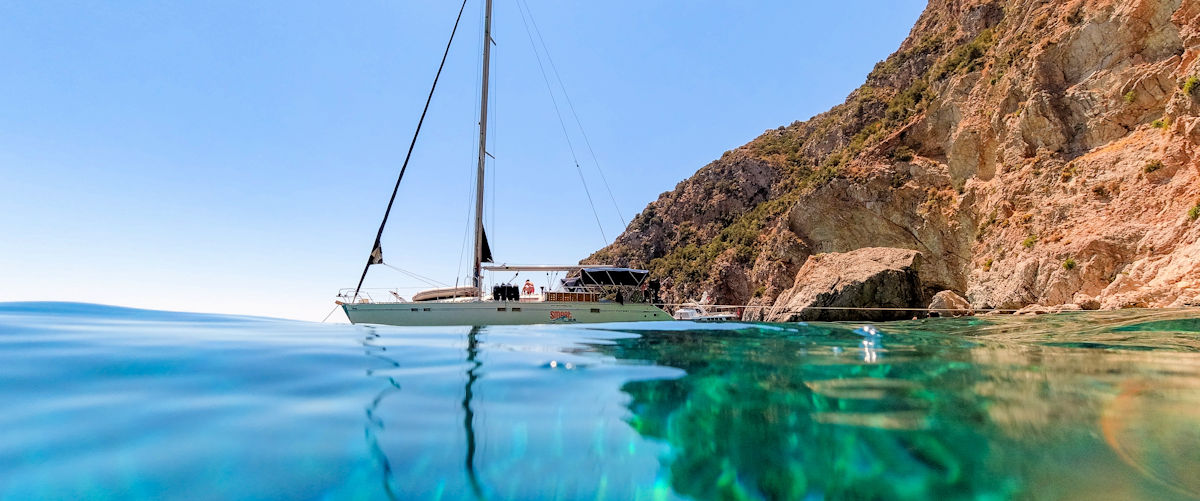
What Is a Sailing Vacation?
A sailing vacation is a holiday where you live aboard a yacht and sail to a new bay or island each day. You swim straight off the boat by day and sleep in your own cabin at night. When a professional skipper is aboard, you need no sailing experience at all.
There are four main ways to take a sailing holiday. You can bareboat, book a private skippered charter, take a cabin on a small-group cruise or join a learn-to-sail course. Each one changes who sails and how you share the cost, and this guide helps you pick.
At Smart Sailing Academy we have spent 14 years on the Turkish Aegean, and we hold one simple belief. Sailing should be a pleasure rather than a hardship, and for many of our guests it becomes a way of life.
The Four Ways to Take a Sailing Vacation
The biggest choice is whether you sail the boat yourself or let a professional skipper do it. After that, you decide whether to keep the yacht private or share it. This table sets the four formats side by side.
| Format | Who it suits | Experience needed | How cost works | Social feel |
|---|---|---|---|---|
| Bareboat charter | Licensed sailors who want full control | Skipper licence and real sea time | You pay for the boat, then fuel, marinas, food and extras on top | Your own crew only |
| Private skippered charter | Families and friend groups who want the yacht to themselves | None | You pay for the whole yacht and a skipper sails it | Private and relaxed |
| Small-group sailing cruise | Solo travelers and couples who enjoy company | None | You book a cabin or spot and share the yacht with other guests | Sociable, with shared meals and evenings |
| Learn-to-sail course | Beginners and aspiring skippers who want a certificate | None for entry-level courses | You pay a course fee for liveaboard training | Small class of fellow trainees |
We run three of these four formats from Cairos Marina in Datça. A private skippered charter gives your group its own yacht and IYT-certified skipper, with a route you shape yourselves. Our cruises take a maximum of six guests, and our courses take a maximum of four trainees.
Why a Small-Group Sailing Cruise Is the Smart Alternative to a Private Charter
A private yacht is wonderful when you have enough people to fill it. Most travelers don't, and paying for empty cabins makes a sailing vacation far more expensive than it needs to be.
A group cruise solves that problem. You book your own place and share the yacht, and its running costs, with a few like-minded guests. Our small-group sailing cruises last one or two weeks aboard 16-metre yachts with ensuite cabins, led by an IYT-certified skipper.

We keep the group to six guests at most, so the boat never feels crowded. Every scheduled program runs even with one reservation, which means a solo traveler can book without waiting for others to sign up. You will never have your trip cancelled because the boat didn't fill!
The social side is where group sailing trips shine. Days end with a sunset swim and a shared meal in the cockpit under a star-filled sky. Many of our guests return year after year, and a good number have become lifelong friends.
A note on wellbeing: the BlueHealth 18-country survey, led by the University of Exeter, associated visits to nearby coastal areas with better recalled wellbeing. Socialising during a visit was also associated with better wellbeing than average. The study did not look at sailing, so treat it as an association rather than proof of a health benefit.
Do You Need Sailing Experience or a Licence?
You need no experience for a skippered charter or a group cruise. The skipper handles the yacht, and you can join in with the ropes and the helm as much or as little as you like.
A licence only matters if you want to bareboat, which means you become the skipper yourself. That is where certificates such as the ICC and IYT come in.
According to the Royal Yachting Association's RYA evidence of competence guidance, the ICC (International Certificate for Operators of Pleasure Craft) is intended to give officials in foreign countries evidence of your competence to operate a pleasure craft, though each visited country decides whether to accept it. The RYA also notes that Greece has not formally adopted the resolution behind the ICC but is still likely to ask visitors for one. The ICC does not guarantee permission to skipper abroad, so check local rules before you book a bareboat.
Our own courses follow the IYT system. Graduates earn an MCA-approved IYT certificate recognised by over 40 countries. With it, you can charter or own a yacht almost anywhere.
The full IYT path runs in steps: International Crew, Flotilla Skipper, Bareboat Skipper and then Yachtmaster, with VHF and RIB Master licences alongside. Experienced sailors can go further with our IYT Yachtmaster courses, covering Coastal, Offshore and Ocean levels.
Learn-to-Sail Vacations: Holiday and Certificate in One
Our training happens entirely on the water. You live aboard, study theory each morning and then put it into practice while sailing to a new bay or island in the afternoon.
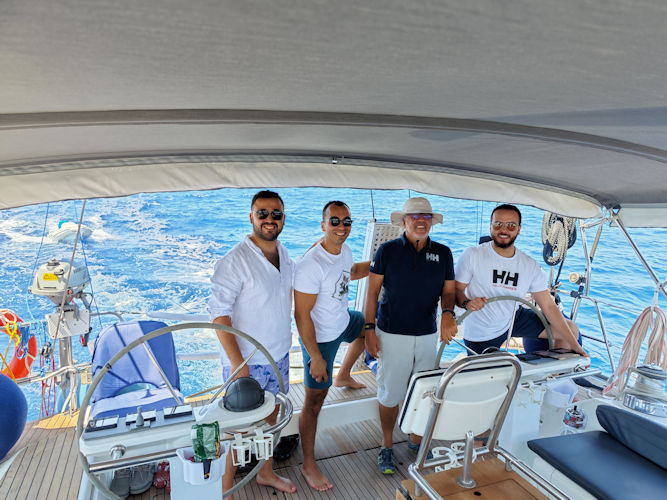
Each class has a maximum of four trainees, so your instructor can watch every tack you make. Topics build day by day:
- Sail handling and trimming
- Navigation and collision rules
- Anchoring and docking
- Man-overboard procedures and safety
- Meteorology and reading the weather
Our liveaboard sailing training courses come in one- or two-week options, with schedules all year round. Swimming stops and holiday activities are part of every course, so you finish with new skills and a real holiday behind you.
How long does it take to learn to sail? A week aboard teaches you how a yacht works, and your instructor will tell you honestly which certificate level suits you.
How Much Does a Sailing Vacation Cost?
Sailing vacation cost depends on four things: the type of charter, the season, the size of the boat and the length of your trip. A private yacht in high summer costs far more than a cabin on a group cruise in a quieter month.
The headline price is only part of the story on many charters. In our years on the water, we have seen most charter quotes include extras such as these, which can add up quickly:
- Security deposit: a refundable sum held against damage to the yacht.
- Fuel: charged by usage at the end of the week.
- Marina and port fees: paid at each harbour you stay in.
- Transit log: the cruising paperwork for the yacht.
- End cleaning: a fee for preparing the boat for the next guests.
- Advance provisioning allowance (APA): a cash fund on crewed charters for food, drinks and running costs.
We work differently. Smart Sailing Academy runs a single, all-inclusive price policy with no hidden costs. That price covers the charter, onboard accommodation, fuel and port fees, sail training, utilities, the transit log and holiday activities.
Food sits outside that list, so ask us how meals and provisioning work on your chosen dates. On a skippered charter we help with provisioning, and restaurant stops are always optional.
Booking a cabin works out cheaper for a simple reason: you pay only for your own place on the yacht. For courses, a two-week Yachtmaster Offshore program is €2,500. For cruise and charter prices, see the dates on our upcoming sailing schedule and ask us for the current price.
Where to Go: Why the Turkish Aegean and Greek Islands
The Caribbean and Croatia both have their fans. For us, though, the best place to go sailing is right outside our door, where the Turkish coast meets the Greek Islands.
Our home base is Marmaris, and our yachts sail out of Cairos Marina in Datça. Within a day's sail you reach pine-covered bays with water so clear you can watch your anchor settle on the sand. Popular routes from Datça include:
- Gökova Bay and its quiet, forested coves
- Hisarönü Bay and its sheltered anchorages
- Bodrum and its castle harbour
- Göcek–Kaş–Kalkan along the turquoise coast
- Greek Islands tours to Rhodes, Kos and Symi
- Longer passages to Santorini, Mykonos and Crete
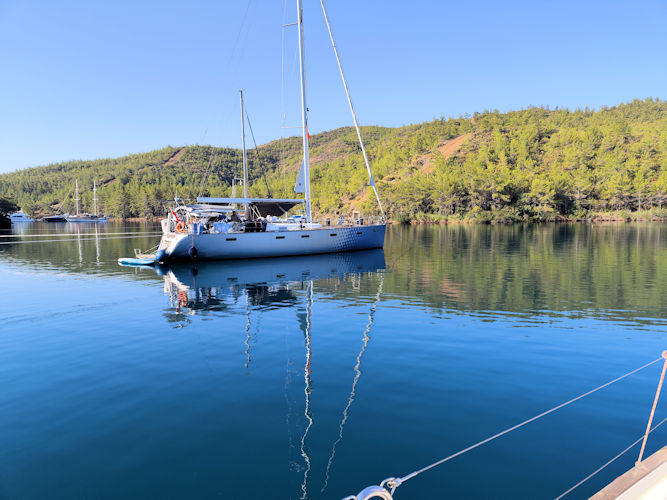
Each route mixes swimming stops with history and local food. You might lunch at anchor below ancient ruins, then share grilled fish and meze in a village harbour by evening.
For a Greek islands sailing vacation, our Santorini sailing route shows a full day-by-day plan. Your skipper can adjust any route to suit the wind and your group's wishes.
When to Go: Seasons and the Meltemi
The Aegean summer brings the Meltemi, a northerly wind also known as the Etesian. It can blow strong, and it shapes how every skipper plans a summer route.
An Etesian winds climatology study in the American Meteorological Society's Journal of the Atmospheric Sciences found outbreaks are most frequent from mid-July to mid-August. That is peak holiday season, so expect livelier sailing then and plan for a few sheltered days.
The shoulder months of spring and autumn are usually gentler, with quieter anchorages. We run schedules all year round, so you can choose the season that suits you. Whatever the month, your skipper reads the forecast each morning and picks the bays that give you the most comfortable day.
Life on Board: What to Expect and What to Pack
A typical day starts with a morning swim off the stern, then coffee as the anchor comes up. You sail to the next bay, stop for lunch at anchor, and spend the afternoon swimming or exploring ashore.
Evenings end in a harbour or a quiet cove. Some nights you head to a taverna, and others you eat on deck as the sunset turns the water gold.
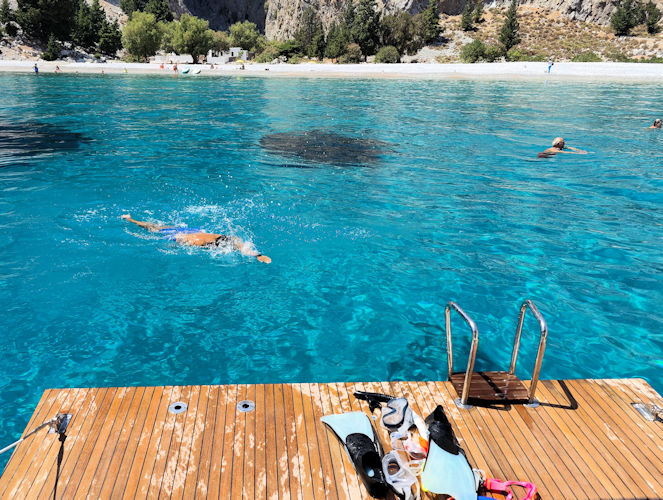
Each 16-metre yacht has ensuite cabins, air conditioning and a full galley, plus a stand-up paddleboard (SUP), a dinghy and an espresso machine. Linens and cleaning are included, and life aboard comes with two simple habits:
- Water conservation: fresh water is stored in tanks, so keep showers short.
- Marine toilet care: marine toilets block easily, so follow your skipper's briefing on what can go in them.
Safety starts with a skipper briefing on day one, covering life jackets and emergencies. In its US Coast Guard boating statistics, the U.S. Coast Guard reports that 87% of 2024 boating fatality victims with known life-jacket status wore none.
Those figures cover all recreational boats in US waters, yet the lesson holds. Our IYT-certified skippers make sure everyone knows when to wear a life jacket.
The CDC traveler sun guidance from the CDC notes that UV light reflected off water can increase the total UV you receive. It recommends a broad-spectrum sunscreen of SPF 30 or higher, reapplied every 2–4 hours and after swimming. Here is what to pack for a sailing vacation:
- A soft bag that folds flat, since hard suitcases are awkward to stow aboard
- Swimwear, and more than one set
- Sunscreen, a wide-brimmed hat and sunglasses
- Non-marking shoes for the deck
- Light layers and a windproof jacket for evenings
- Your passport, travel insurance and any sailing certificates
Are Sailing Vacations Good for Families?
Yes, and a private skippered charter is the best fit. Your family has the yacht to itself, so you set the pace and keep the routine that works for your children.
The skipper handles the sailing, which leaves parents free to enjoy the day. Calm bays make swimming easy, and the SUP and dinghy keep older children busy for hours.
Ashore, there are nature walks and historical sites to explore together. Ensuite cabins and air conditioning mean everyone sleeps well.
How to Plan and Book Your Sailing Vacation
Planning a sailing vacation takes five steps. Peak summer dates fill first, so book those well ahead.
- Pick your format. Choose a cabin on a group cruise, a private skippered charter or a liveaboard training course.
- Pick your dates and route. Decide on one or two weeks, then the season and the bays or islands you want to see.
- Check the schedule and reserve. Book your place on your chosen date. Programs run even with one reservation, so solo travelers can book confidently.
- Book your flights. Fly to your nearest airport, and we will advise you on the best way to reach the marina.
- Pack and arrive for check-in. Bring your soft bag and documents to Cairos Marina in Datça, and your skipper will welcome you aboard.
Tansel, our owner and chief instructor, is happy to answer questions before you book. Why wait? Life doesn't!
Sailing Vacation FAQs
These are the questions we hear most often from first-time guests. If yours is not here, just ask us.
Where is the best place to go sailing?
It depends on the season and your experience. For sheltered bays and a wide choice of islands, the Turkish Aegean and the Greek Islands are hard to beat.
How much do sailing holidays cost?
The price varies by format, and booking a cabin on a group cruise is the most affordable way to sail without a licence. Check the schedule for dates, then ask us for the single all-inclusive price.
Do I need sailing experience to go on a sailing vacation?
No, a skipper sails the yacht on our cruises and charters. You only need a licence and experience if you want to bareboat.
What is the difference between a bareboat and a skippered charter?
On a bareboat charter you are the skipper, so you need a recognised licence. On a skippered charter a professional sails the yacht while you relax or learn.
Can I go on a sailing vacation alone?
Yes, our group cruises welcome solo guests. Every scheduled program runs even with one reservation.
Is a sailing vacation suitable for families with children?
Yes, and a private skippered charter is ideal because your family has the whole yacht. The skipper sails while the family swims and explores.
Ready to Sail the Aegean?
Check the live schedule, pick your format and reserve your place. Programs run even with one reservation.